
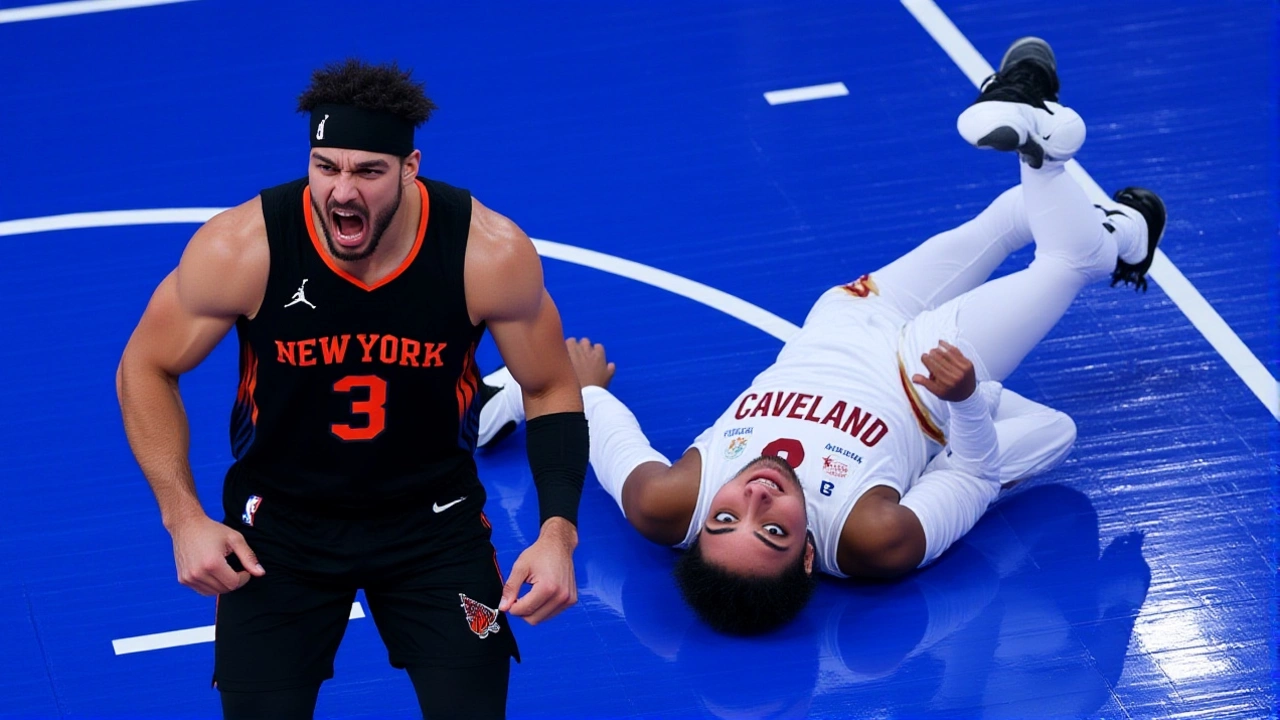
When Josh Hart, forward for the New York Knicks, erupted for a playoff career-high 26 points on Thursday night, he didn’t just break out of his slump—he broke the internet with a scathing critique of modern basketball strategy. The win at Madison Square Garden gave the Knicks a commanding 109-93 victory over the Cleveland Cavaliers, but the real headline wasn’t the score. It was Hart’s postgame rant about analytics, comparing them to “a lamp post to a drunk person.”
Here’s the thing: this wasn’t just another stat line. This was the moment the narrative shifted. For weeks, critics had pointed to Hart’s inconsistency as a liability in high-stakes games. Then came Game 2 of the Eastern Conference Finals, where the Cavs tried to shut down Jalen Brunson and Karl-Anthony Towns, leaving Hart wide open. He took advantage. And then he told the world exactly how he does it.
The Performance That Sparked the Debate
Let’s look at the numbers first, because they’re undeniable. Hart finished with 26 points, shooting 10-of-21 from the field. He hit five three-pointers—three of them in the second half alone when the Cavaliers were struggling mightily from deep (just 3-of-14). He also grabbed seven rebounds and recorded two blocks. It was efficient, timely, and brutally effective against a defense that had apparently decided he wasn’t worth guarding.
But the context matters more than the box score. The Cavaliers’ game plan was built on data-driven decisions: limit their stars, force others to beat you. They assumed Hart would fold under pressure or miss shots in clutch moments. Instead, he capitalized on the space they created. In the second half specifically, Hart went 3-for-4 from beyond the arc while the entire Cavs squad managed only 3-for-14. That’s not luck. That’s execution exploiting a strategic blind spot.
"It was Josh Hart who stepped up as New York's leading scorer," noted Pro Football Network, highlighting how the defensive focus on Brunson and Towns backfired spectacularly. The Cavs left him open repeatedly, and Hart punished them every time.
"A Lamp Post to a Drunk Person"
After the final buzzer, reporters asked Hart about comments made earlier by Mike Brown, former head coach of the Golden State Warriors. Brown had compared Hart to Andre Iguodala, suggesting both players needed to "ignore analytics to compete." Hart didn’t mince words in response.
"You know, at a certain point, they're a lamp post to a drunk person," Hart said, referring to analytics. "You can lean on them, but it won't get you home." He added, somewhat cryptically, "So, at a certain point..." before trailing off, letting the metaphor hang in the air like smoke after a gunshot.
Another version of the quote, reported by Pro Football Network, had him saying, "I never [was] an analytics guy... At a [certain point], they're a lamp to a person... You can lean on them, it won't get you home. So, at a certain [point], you've got to have a feel for the game." Whether transcribed perfectly or not, the message was clear: Hart believes intuition trumps spreadsheets when it counts.

Why This Matters Beyond the Court
This isn’t just about one player’s hot streak. It’s a broader conversation happening across the NBA right now. Teams are increasingly relying on advanced metrics to dictate rotations, shot selection, and even defensive assignments. But what happens when those models fail? What happens when the human element—the instinct, the gut feeling, the unquantifiable swagger—becomes the difference between winning and losing?
Hart’s performance suggests that sometimes, trusting your instincts pays off bigger than following the algorithm. His 26-point explosion pushed his playoff averages up to 11.8 points, 8.4 rebounds, and 4.4 assists per game, with improved shooting percentages of 44.7% from the field and 30.4% from three-point range. These aren’t blockbuster numbers for a superstar, but for a role player stepping up in the biggest stage imaginable? Absolutely significant.
Mike Brown’s Comparison and Historical Context
Mike Brown’s comparison of Hart to Andre Iguodala is interesting, if slightly flawed. Iguodala was known for his versatility, leadership, and ability to make plays without dominating stats. Hart shares some of those traits—defensive tenacity, energy, playmaking—but his offensive game has evolved significantly since joining the Knicks. Where Iguodala often played within system constraints, Hart seems comfortable taking ownership when given the chance.
Brown’s comment likely stemmed from observing Hart’s tendency to thrive in chaotic situations rather than structured ones. There’s truth to that. Hart doesn’t always fit neatly into analytical frameworks. He thrives in moments where creativity beats calculation.
What’s Next for the Series?
The Knicks now hold a 2-0 lead heading into Game 3, which will shift locations—reports indicate the series moves to Cleveland next. Expect the Cavaliers to adjust their defensive scheme dramatically. No more ignoring Hart. If they double-team Brunson and trap Towns, they’ll need to account for Hart’s newfound confidence—and his willingness to shoot whenever he sees daylight.
Meanwhile, Hart’s remarks have ignited debates among coaches, analysts, and fans alike. Some argue he’s oversimplifying complex strategies. Others see validation for their belief that basketball remains an art form, not just a science experiment. Either way, Hart has inserted himself into the center of the discussion—not just as a performer, but as a philosopher of sorts.
Frequently Asked Questions
How did Josh Hart perform in Game 2 of the Eastern Conference Finals?
Josh Hart scored a playoff career-high 26 points, shooting 10-of-21 from the field and hitting five three-pointers. He also contributed seven rebounds and two blocks, helping the New York Knicks defeat the Cleveland Cavaliers 109-93 and take a 2-0 series lead.
What did Josh Hart mean by calling analytics "a lamp post to a drunk person"?
Hart used the metaphor to suggest that while analytics can provide support or guidance, they cannot guarantee success on their own. Just as a drunk person might lean on a lamppost for stability but still struggle to walk home, teams relying solely on data may lack the intuitive decision-making required in critical moments.
Who originally compared Josh Hart to Andre Iguodala?
Former Cleveland Cavaliers head coach Mike Brown made the comparison during pre-series commentary, noting that both Hart and Iguodala succeeded despite—or perhaps because—they operated outside strict analytical frameworks. Hart responded directly to these comments after Game 2.
How did the Cavaliers' defensive strategy affect Josh Hart's performance?
By focusing heavily on limiting Jalen Brunson and Karl-Anthony Towns, the Cavaliers left Hart largely unguarded. He exploited this matchup, particularly in the second half when he shot 3-for-4 from three-point range while the rest of Cleveland struggled from deep.
Where will Game 3 of the Eastern Conference Finals be played?
Game 3 will be held in Cleveland, shifting the momentum away from Madison Square Garden. The Cavaliers will need to adapt quickly to contain Hart’s emerging role as a primary scoring threat alongside Brunson and Towns.

Write a comment